

The Cost of Cyber Disruption for Irish SMEs
Cyber threats continue to evolve, and so does their impact on Irish businesses. The latest Hiscox Cyber Readiness Report reveals that successful cyberattacks are putting significant pressure on Irish SMEs, affecting operations, growth plans and customer trust. While many businesses are investing in cyber resilience, the findings highlight the importance of being prepared, not just protected.
Download the report to explore the latest cyber trends affecting Irish businesses and discover practical steps to strengthen resilience.
Key Findings
Almost a full working week lost to cyber disruption
Irish businesses that experienced a successful cyberattack reported an average of 33.93 hours of operational disruption over the previous 12 months, equivalent to almost a full working week.
Cyber incidents are limiting growth
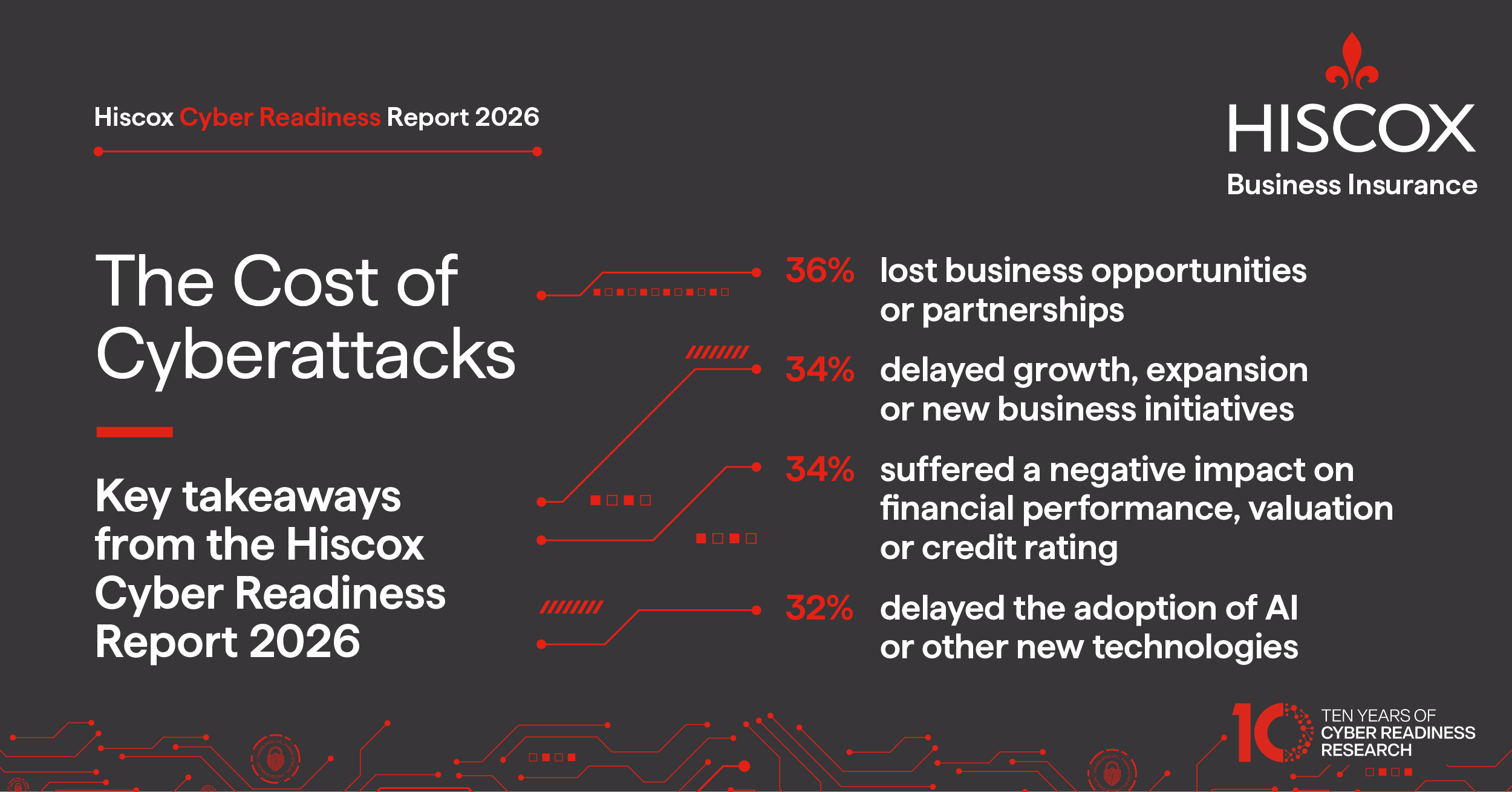
For businesses impacted by a successful attack:
- 36% lost business opportunities or partnerships
- 34% delayed growth, expansion or new initiatives
- 34% reported an impact on financial performance, valuation or credit rating
Reputation remains a major concern
The consequences of cyber incidents extend beyond operational disruption:
- 48% cited reputational damage or loss of customer trust
- 47% identified operational downtime as a key concern
- 47% highlighted supply-chain or third-party disruption
Cybersecurity is becoming a leadership priority
More organisations are recognising cyber risk as a business issue rather than simply an IT challenge. Among affected businesses, 36% linked leadership compensation or performance measures to cybersecurity goals.
Irish businesses are investing in resilience
The research shows that Irish SMEs are taking positive action to strengthen their cyber resilience:
- 68% are updating employee cybersecurity training
- 57% are investing in cybersecurity software
- 55% are hiring additional staff to support cybersecurity
- 67% currently have cyber insurance
These findings suggest that Irish businesses increasingly recognise that cyber resilience requires a combination of people, technology and process.
Building a more resilient business
No business can eliminate cyber risk entirely. However, preparation can significantly reduce disruption and improve recovery.
The businesses making the greatest progress are those that focus on:
- Clear ownership and accountability
- Employee awareness and training
- Practical and proportionate security controls
- Tested incident response plans
- Access to specialist support when needed
Cyber insurance can also play an important role within a broader resilience strategy, providing access to financial protection and specialist expertise when an incident occurs.
About the research
The Hiscox Cyber Readiness Report 2026 was conducted by Wakefield Research among 6,800 cybersecurity decision-makers and subject-matter experts in businesses with fewer than 250 employees across ten markets. The Irish sample included cybersecurity decision-makers in 300 businesses with fewer than 250 employees. Fieldwork was conducted between the 5th and 17th June 2026.
Findings relating to disruption and post-attack consequences were gathered from organisations that experienced a successful cyberattack during the previous 12 months.
An in-depth evaluation: The Maturity Model
The Maturity Model offers insurance brokers a robust review of a company’s cyber risk profile.
It allows company’s and brokers to assess and gauge the firms’ strengths in six key cyber security areas, using an in-depth question set.
The result is a gold standard, value-added service, allowing companies to see where they have gaps in their cyber security operations across three key functions – people, process and technology.